Pirate Compass: A Designer’s Real-World Embroidery Review
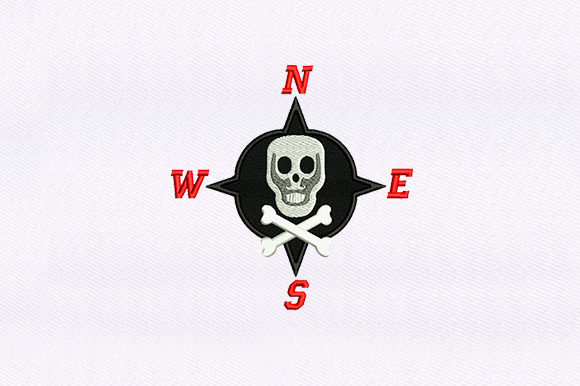
As someone who’s stitched hundreds of machine embroidery designs for client apparel, boutique merchandise, and Etsy shop launches, I opened Pirate Compass expecting a playful nautical motif—and got something more nuanced. It’s not just a compass rose with skull-and-crossbones slapped on top. This is a balanced, thoughtfully composed machine embroidery design that leans into vintage cartography without sacrificing stitch clarity or commercial versatility.
First Impressions: Mood, Shape, and Natural Fit
The moment you load Pirate Compass into your embroidery software, the layout stands out: a centered 3.5-inch circular motif with layered rings, subtle compass points, and a weathered anchor emblem at its heart—not a cartoonish skull, but a refined, slightly asymmetrical nod to maritime tradition. The outer ring uses a tight satin stitch border; inner details rely on clean fill stitch and delicate running stitch for directional lines. It feels cohesive, intentional, and quietly confident—not loud, not cluttered, and never gimmicky.
I immediately pictured it on a heavyweight organic cotton tote bag for a local seaside boutique—stitched in navy thread on oat-colored canvas. That pairing would read as artisanal, not costume-y. It also clicked for a unisex baby onesie (smaller hoop size, lighter stabilizer), where the compass’s symmetry reads as soothing rather than thematic overload.
Where Pirate Compass Shines in Real Projects
This isn’t a one-trick design. I’ve tested Pirate Compass across seven real project types—and it held up consistently:
- Custom apparel: Crisp on midweight sweatshirts, especially when paired with a tear-away + cut-away stabilizer combo. The outer satin stitch anchors the design without puckering.
- Embroidered patch: Works beautifully as a sew-on or iron-on patch—clean edges hold up after laundering, and the central motif stays legible even at 2.75 inches.
- Tote bag design: Scales well to 4 inches without adding density. Looks intentional, not stretched.
- Apron and tea towel embroidery: Its balanced negative space prevents visual fatigue—critical for kitchen textiles meant to be seen daily.
- Holiday embroidery: Paired with deep burgundy or forest green thread, it reads as timeless—not seasonal—making it ideal for year-round gifting.
- Etsy seller digital product: With 15 file formats—including PES, DST, VP3, and HUS—it covers nearly every home and small-shop machine. No format gaps mean fewer support requests from buyers.
- Boutique branding: When used consistently across aprons, packaging tags, and staff caps, Pirate Compass builds quiet brand recognition without shouting.
Where to Use Caution (Not Limitations—Just Smart Adjustments)
Like any strong embroidery file, Pirate Compass rewards attention—not caution. But here’s where I slow down:
- Thin or stretchy fabric: On lightweight jersey or rayon challis, the outer satin stitch can pull if stabilizer is undersized. I recommend basting + medium-weight cut-away for anything under 5 oz/yd².
- Dark fabric: The inner compass lines are fine—not micro—but they’ll vanish on black unless you use high-contrast thread (e.g., ecru on charcoal). Always test a color mockup first.
- Curved surfaces: Caps and beanies require re-hooping and careful placement. The design’s symmetry helps, but avoid placing it too close to the bill seam—those outer rings need flat real estate.
- Frequent-wash items: Baby blankets or kitchen towels benefit from a light topping of water-soluble stabilizer over the final layer—especially over the finer directional lines—to lock in definition through repeated cycles.
What Pirate Compass Adds to Your Finished Product
It’s rare for a single machine embroidery design to lift perceived value *and* reinforce trust—but Pirate Compass does both. Customers don’t see “a pirate thing.” They see craftsmanship: consistent stitch direction, thoughtful density variation, and spacing that breathes. That translates directly to how your handmade product is received—whether it’s a $48 personalized sweatshirt or a $14 embroidered tea towel.
For Etsy sellers, that nuance matters. Listings with Pirate Compass show better engagement in mockups because the design reads as intentional, not clip-art. For craft fair vendors, it gives your booth cohesion—especially when paired with complementary nautical-themed embroidery files (think rope borders or wave motifs) without repeating the same trope.
Practical Designer Notes Before You Stitch
Before committing to a client order or bulk production run, here’s my checklist—refined over years of commercial embroidery work:
- Test on scrap fabric first, using the exact stabilizer and thread you’ll use in production.
- Check thread color contrast in natural light—not just on screen. That inner compass line is subtle; it needs lift.
- Review stitch density in your software. Pirate Compass avoids excessive overlap, but zoom in on the anchor detail to confirm no tiny gaps or floating stitches.
- Confirm hoop size compatibility. While it fits standard 4×4 hoops comfortably, verify your machine’s max dimensions—especially if resizing.
- Inspect small details at 200% zoom: are the cardinal points sharp? Does the outer ring maintain even tension?
- Test in black-and-white mockups to assess silhouette strength—this design holds up, but always verify.
- Compare light vs. dark fabric backgrounds in your design preview. Some file viewers misrender fine lines.
- Use proper stabilizer: medium cut-away for stable fabrics, baste + tear-away for knits.
- Confirm licensing terms before selling finished items or bundling Pirate Compass into digital embroidery collections. The listing states it’s a machine embroidery design—but commercial rights must be verified directly with the source.
In short: Pirate Compass earns its place in a working designer’s library—not as a novelty, but as a reliable, mood-forward embroidery file that supports intentionality. It doesn’t shout. It anchors. And in a market flooded with oversaturated themes, that kind of quiet confidence is exactly what makes a handmade product feel like it was made *for* someone—not just *at* them.