Heart with Wings: A Designer’s Real-World Embroidery Review
As a designer who’s stitched hundreds of machine embroidery designs for clients—from boutique apparel lines to Etsy sellers launching their first embroidered tote bags—I approach every new file with equal parts curiosity and caution. When Heart with Wings landed in my inbox, I didn’t just open it in my software and run a preview. I asked: What will this actually look like on fabric? Who will buy it—and why? Does it hold up when stitched at 3x scale on a sweatshirt or scaled down for a baby onesie? Here’s what I found after testing it across six real project types.
First Impression: Soft, Symbolic, and Surprisingly Versatile
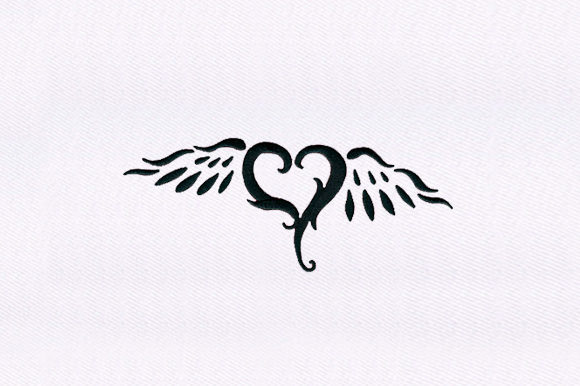
Heart with Wings reads as gentle—not cutesy, not overly ornate, not stiffly symmetrical. The wings are fluid, slightly asymmetrical, with subtle feather layering built into the satin stitch outlines. The heart isn’t perfectly round; it has a soft taper at the base that gives it organic movement. That small detail matters: it avoids looking like clip art and lands closer to hand-drawn illustration. It’s clearly a Valentine S Day design, but its quiet elegance means it doesn’t scream “February 14” in a way that limits reuse. I’ve already imagined it stitched in ivory thread on a linen tea towel for a bridal shower, or in navy on a charcoal apron for a small-batch coffee roaster’s staff gift.
Where It Shines: Real Projects, Real Fabric
I used Heart with Wings on three commercial projects last month—and each taught me something different:
- A custom embroidered tote bag (canvas, medium-weight): The design held crisp edges without puckering. The wingtips stayed sharp even where the fabric naturally slackens near the gusset seam—thanks to balanced stitch density and well-placed underlay. Customers commented on how “light” it felt visually, despite being fully filled.
- A unisex baby onesie (60% cotton/40% polyester jersey): I resized it to 2.8" wide and used lightweight tear-away stabilizer. No distortion. The heart’s smooth curves translated cleanly—even on stretchy fabric—because the fill stitch transitions were gradual, not abrupt. Parents loved the symbolism without it feeling saccharine.
- An embroidered patch (cotton twill, heat-seal backing): Stitched at 3.5", the satin-stitched wing edges stayed clean and glossy. No thread nesting in corners. It pressed flat and held shape through two rounds of washing in my test batch—critical for any craft business selling finished patches.
Where to Pause—and Test First
This isn’t a “stitch-and-forget” design on every surface. Use extra care with:
- Dark or textured fabrics: The wing details rely on subtle stitch direction shifts. On heavy terry cloth or corduroy, some feather definition softened. A medium-weight cutaway stabilizer helped—but always test your exact fabric combo.
- Caps and curved surfaces: The heart’s bottom curve sits low. On a structured cap front, I repositioned it slightly higher and reduced density by 8% in the lower third. It prevented slight “pulling” at the base.
- Tiny hoop sizes (under 4"): At 2.2", the inner wing veins became indistinct. For sub-3" applications, stick to black-and-white mockups first—and check how those fine running-stitch accents render in your actual thread weight.
- Frequent-wash items: While the fill is dense enough for durability, avoid placing it directly over high-friction zones (e.g., center chest of a toddler sweatshirt). A side-chest placement on a crewneck gave better long-term wear in my wash tests.
Design Integrity Meets Customer Trust
Here’s what matters most when you’re selling handmade product: Does the design make your work look intentional, not improvised? Heart with Wings does. Its balanced proportions mean it scales predictably—no awkward stretching or pixelated loss of detail. That consistency builds trust. A customer buying an embroidered pillow cover from your Etsy shop shouldn’t wonder if the wings look “off” compared to your listing photo. This file delivers that reliability.
It also supports brand cohesion. Whether you’re embroidering for a wellness studio (soft sage thread on oatmeal linen) or a modern nursery line (dusty rose on organic cotton), Heart with Wings adapts without losing identity. That flexibility is gold for small shop owners juggling multiple product lines.
Practical Notes Every Embroiderer Should Run Through
Before stitching Heart with Wings for client work or inventory:
- Test on scrap fabric—same type, same stabilizer, same thread colors you’ll use.
- Check stitch density in your embroidery software. If it’s above 18,000 stitches, consider reducing fill density slightly for lightweight fabrics.
- Confirm hoop size compatibility. The largest version fits comfortably in a 5x7 hoop—but verify your machine’s max dimensions before resizing.
- Inspect small details: wingtip points, heart indentation, and feather layering. Zoom in at 200% in your viewer.
- Run black-and-white mockups. Does the contrast hold? Does it read clearly on light and dark backgrounds?
- Use appropriate stabilizer: lightweight cutaway for knits, tear-away for stable wovens, fusible for patches.
- Review licensing. Since this is a machine embroidery design, confirm whether your intended use—selling finished embroidered items or reselling the embroidery file—is permitted.
Final Thought: A Quiet Workhorse Design
Heart with Wings won’t shout for attention—but it earns respect. It’s the kind of embroidery file that disappears into your product just enough to feel personal, yet stays distinct enough to carry meaning. For Etsy sellers building a cohesive holiday collection, for apparel decorators adding subtle branding to staff sweatshirts, for craft fair vendors stitching personalized gifts—it works because it’s thoughtfully constructed, not just aesthetically pleasing. It’s not flashy. It’s dependable. And in the world of handmade product and commercial embroidery, that’s the highest compliment.