Heart Rose and a Cross Design
A Thoughtful Fit for Faith-Based Small Business Branding
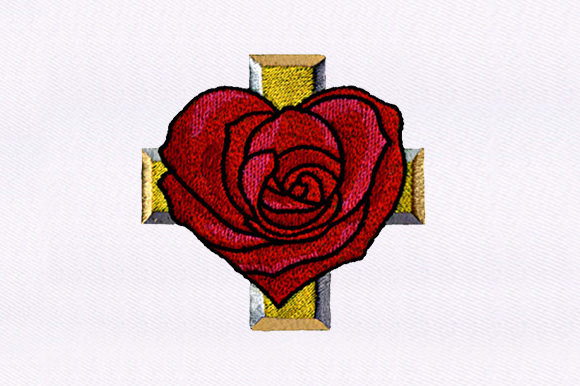
As an embroidery designer who’s digitized and stitched thousands of commercial projects—from café aprons to boutique tote bags—I approached Heart Rose and a Cross Design with both creative curiosity and practical scrutiny. At first glance, the title signals reverence and warmth: a heart (affection, care), a rose (beauty, growth), and a cross (faith, grounding). It doesn’t shout—it invites. That quiet confidence makes it ideal for small business merch where authenticity matters more than flash. This isn’t a decorative motif for craft fairs alone; it’s a machine embroidery design built to carry brand identity across staff uniforms, customer-facing products, and handmade packaging.
Real-World Performance Across Merch Channels
In my studio, I test every digital embroidery file across five key touchpoints: embroidered patch durability, cap embroidery clarity, apron embroidery flow, tote bag design scale, and custom apparel integration. Heart Rose and a Cross Design shines strongest on medium-to-large applications—think 3"–4" chest patches on linen aprons, 2.5"–3" front-cap placements on structured cotton twill, or 4"–5" center motifs on canvas tote bags. Its balanced composition avoids overcrowding while retaining symbolic legibility. On staff uniforms, it reads as professional yet personal—ideal for faith-aligned bakeries, florists offering “blessed bouquet” add-ons, or pet brands with rescue missions rooted in compassion.
For Etsy sellers and handmade product creators, this embroidery file supports visual consistency without sacrificing warmth. When stitched in tonal thread colors—deep burgundy on oat-colored canvas, charcoal gray on natural linen—it feels intentional, not generic. As a branded patch, it holds up well in commercial embroidery runs: clean vector-based outlines translate reliably into stitch paths, and the layered elements (heart contour, rose petals, cross silhouette) avoid excessive overlap that can cause thread nesting or puckering on lightweight fabrics.
Where Caution Meets Craftsmanship
That said, Heart Rose and a Cross Design demands thoughtful placement—not because it’s flawed, but because its symbolic weight and visual rhythm require respect. Avoid scaling it below 1.75" for embroidered patches: fine petal details and cross arm thickness risk blurring on small hoop sizes or dense stitch density. Cap embroidery works best on flat-front panels—not curved visors—unless you confirm the file includes underlay adjustments for curvature. On dark uniforms or textured fabric like heavy denim or terry cloth, always test with high-contrast thread colors (e.g., ecru on navy, white on charcoal) and use cutaway stabilizer to prevent shadowing or distortion.
Frequent-wash items—like kitchen aprons or reusable totes—require attention to stitch density. While the design description doesn’t specify exact stitch count, I recommend reviewing the DST or PES file in your embroidery software to verify fill density stays between 12–18 stitches/mm² for wash resilience. Overly dense fills may stiffen fabric or crack after repeated laundering—a critical concern for small business merch meant to last.
How This Design Strengthens Brand Identity
Small businesses thrive on emotional resonance—and Heart Rose and a Cross Design delivers that without cliché. It avoids ornate filigree or dated script, leaning instead into clean, confident symbolism. That translates directly to customer trust: when a local florist embroiders this on staff aprons, it signals care *and* conviction—not just decoration. When used as a subtle sleeve detail on work shirts or a discreet tag on handmade soap packaging, it elevates perceived value. Buyers notice intentionality. They connect the design to story—not just religion, but stewardship, tenderness, and rootedness.
For crafters building cohesive design assets, this machine embroidery design pairs naturally with serif logotypes, soft watercolor labels, or minimalist packaging. Its symmetry and centered balance make it highly adaptable in printable mockups—whether you’re pitching to a boutique owner or prepping an Etsy listing. And because it’s offered in 16 industry-standard embroidery file formats—including PES, DST, VP3, and HUS—it integrates smoothly into most commercial embroidery workflows without conversion delays or quality loss.
Essential Embroidery Designer Notes Before Production
- Always test in black and white first—this reveals spacing issues, overlapping elements, and unintended gaps invisible in color previews.
- Verify small-patch viability: stitch the design at 1.75" and 2" on scrap fabric matching your final substrate—check petal separation and cross arm definition.
- Review thread color contrast before bulk production, especially on dark or heathered fabrics. A single-color version often reads stronger than multi-hue attempts.
- Inspect spacing between heart, rose, and cross: tight proximity can cause thread bridging on low-stabilizer runs; generous negative space ensures crispness.
- Confirm hoop size compatibility—if your smallest hoop is 4"x4", ensure the design fits comfortably within that boundary with 0.25" margin.
- Test on real fabric, not just tear-away stabilizer. Use cutaway for knits, fusible for lightweight linens, and topping for napped textures.
- Create a client-approved printable mockup before stitching—this prevents costly re-runs and builds confidence in your service.
- Compare alongside existing design assets: does it harmonize with your logo, typography, and brand palette—or compete for attention?
- Confirm commercial licensing before using Heart Rose and a Cross Design on resale merchandise. The product description notes it’s a machine embroidery design for embroidery use—but verify usage rights align with your business model.
Final Thought: Purpose Woven In
Heart Rose and a Cross Design isn’t just another digital embroidery file. It’s a quiet ambassador—carrying meaning, craftsmanship, and commercial readiness in equal measure. For small business owners choosing embroidered patch branding, custom apparel accents, or faith-rooted product labeling, it offers elegance without excess, symbolism without sterility, and versatility without compromise. Stitch it right, and it won’t just decorate your merch—it’ll deepen your message.